

Frequently asked questions.
RV Tow Lantern FAQ
What does RV Tow Lantern Do?
RV Tow Lantern is an independent online advisory service that helps RV buyers make safe, informed decisions before they purchase. Our services include tow vehicle and RV compatibility analysis, side-by-side RV model comparisons, and concierge-level buyer guidance built from real-world RV ownership experience.
What makes your guidance more reliable than other RV resources?
Most RV advice focuses on one small piece of the puzzle — the truck, the trailer, or the gear. We guide you through the entire journey: what to know before you buy, how to avoid expensive mistakes, what actually matters on your first trips, and how to grow confidently into long-term or full-time RV life, if that’s your goal.
We don’t speak in theory. We’ve lived this cycle ourselves, made the wrong purchases, learned the hard lessons, and refined what truly works. Our goal is simple: give you clear, real-world guidance that saves you money, time, and frustration — so you start your RV journey with confidence, not regret.
How do I find my tow vehicle weight (and payload) number specifications?
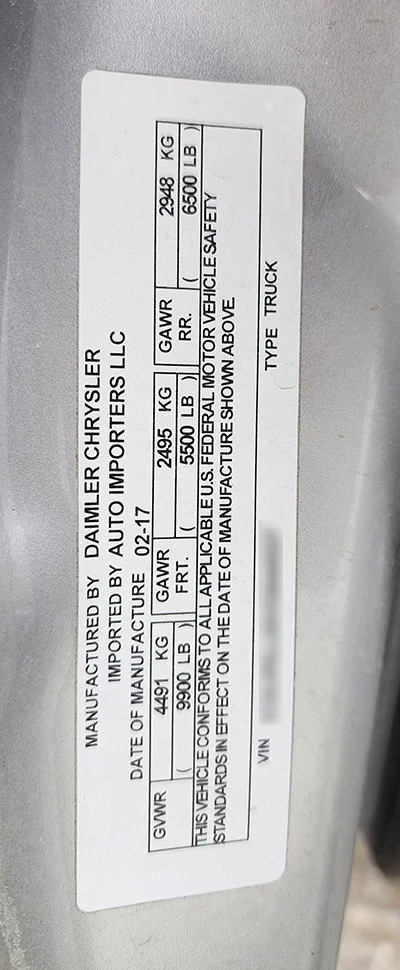
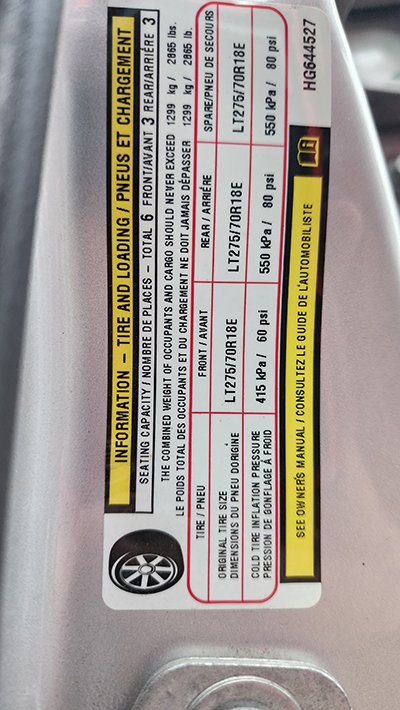
On your driver-side door and door jam, typically, are a number of stickers that tell you about tire inflation and other vehicle weight information. Please take clear/sharp pictures of all of them in their unaltered, high-quality format. We’ll do the necessary work of decoding what each means for your computations and recommendations.
How do I find my RV weight numbers?
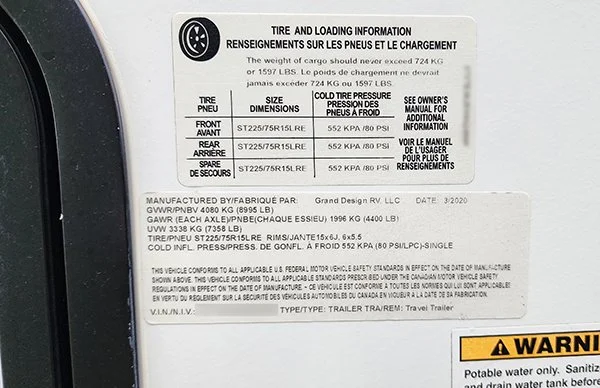
Similar to vehicle informational decals, RVs have the same requirements by the DMV printed somewhere obvious on the RV. Typically, this will be on the front left (driver/utility) side of the RV or in the inner front compartment of the RV. Please take clear/sharp pictures of all of them in their unaltered, high-quality format.
How do I find my tow vehicle capacity numbers?
Unfortunately, this is not always straight forward. The worst thing you can do is google your vehicle and take the automatic or A.I. summary at the top of the page. This will almost always be wrong. The easiest way is to look at the original window sticker that came with your vehicle when it was new, if you’re fortunate enough to have that and if it was actually specified there. But, honestly, the path of least resistance is to go to a local dealership that sells the same brand of vehicle and ask them for assistance on finding the exact numbers. A trusted and certified auto machinic can also help you find what those numbers are as well.
If you’re more technical and want to find this out for yourself, you can look it up in your owners' manual, but you’ll need to know all the vehicle options such as the engine and axle ratio. Below is a picture of what our Tahoe has in the owner’s manual.
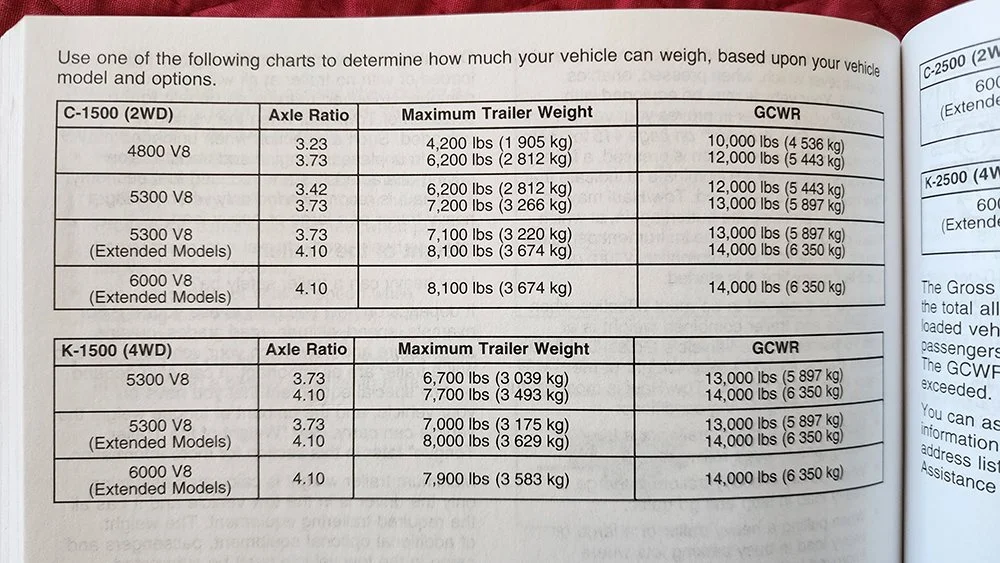
I can recall from the original window sticker that we have the 4x4 version with the 5.3L V8, so this helps us narrow down quickly to the second table, second entry down. But what about the axle ratio? Well, that’s where the not-so-obvious answer comes from. Once again, it would be easy if you had the original window sales sticker as it would tell you the axle ratio. If not, then you’ll need to find the RPO code plate/decal (which could be in the inner glovebox or passenger-side door), decode the sales codes online until you find the one corresponding to the axle ratio, and then use that for the final part of matching it up to the grid or table in the owner’s manual.
At RV Tow Lantern, we use an online VIN decoder, which will usually list all the RPO codes (aka sales codes or build options) for a vehicle. For example, if we put in the VIN for our Tahoe, this is what it brings back:
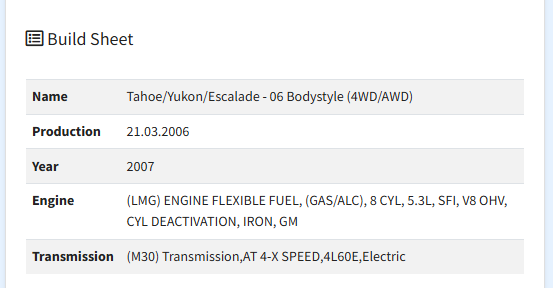
Well, that’s not too helpful - there’s no RPO codes listed for this vehicle, most likely due to its age. You can see that we get some of the info like the drivetrain, but nothing for the axle ratio. So, in this example, we’ll have to go a step further and find the RPO plate/decal on the vehicle. If you don’t know where this is, Google “where are my RPO codes for [your make, model, and year]”. I happen to know this decal/plate is in the inner panel of the glovebox and looks like this:
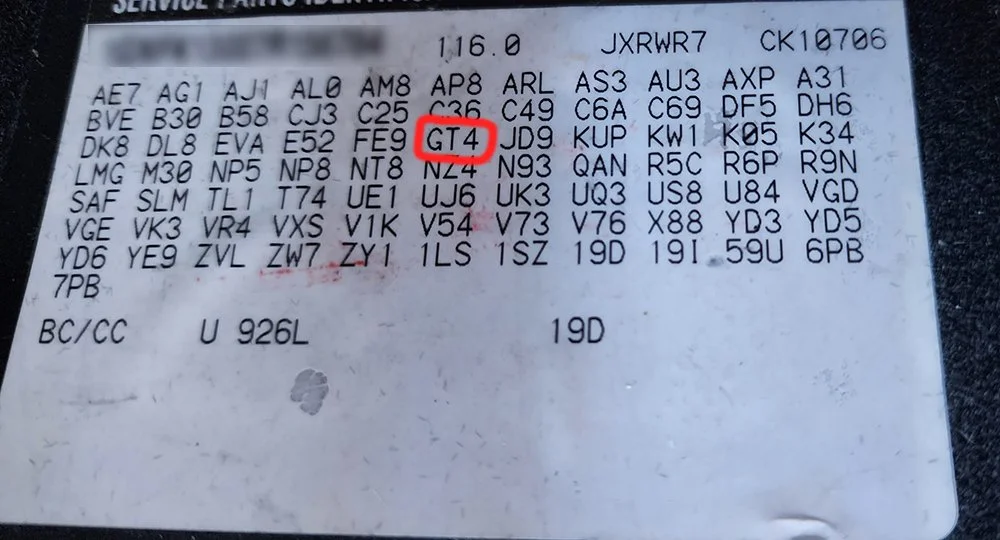
I went to Google and typed “what are the different sales codes Tahoe for axle ratio” and it returned a summarized list of possibilities - all starting with ‘G’. It’s quick to run through the RPO codes above to find that we have a GT4, which matches to the 3.73 ratio, as seen below.
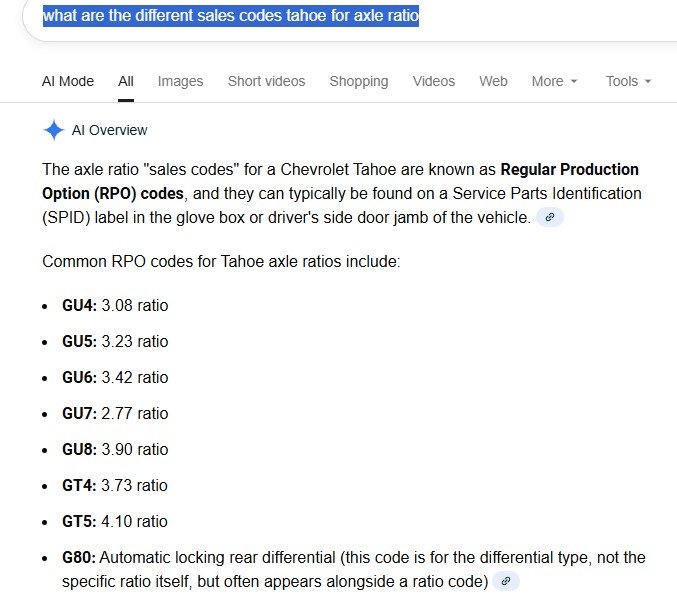
Therefore, if you go back up a couple illustrations to the owner’s manual you can see that we can complete our search for out Tahoe and identify that it has a max tow rating of 6,700 lbs.
Note: if you’re purchasing one of our services, we need a photo of this RPO code plate/decal right from the beginning. Naturally, we have a wider breadth of ways to find and derive some of this information, but this helps reduce the number of times we have to come back to you asking for more tow vehicle information.
Is Tow Capacity or Payload More Important?
The key to remember is that you will almost always run out of payload capacity (the weight on the tow vehicle) before you run out of tow capacity. We still need to briefly analyze tow capacity first, but then we go directly into payload capacity as that will be our final limiter.
What are your deliverables after I elect and pay for a service?
For the Tow Vehicle & RV Compatibility and the RV Model Comparison services, you will receive a custom report based on the information you have submitted. For our signature service, the RV Buyer Concierge, you will be given extra care with the option of three included calls as we really get to know you and your RV needs. We will be in communication with you as you proceed forth and I will provide materials to you as each phase of your journey progresses.
What is the deliverable for the downloadable RV Buyer Blueprint?
The RV Buyer Blueprint encapsulates over 10 years of personal on-the-road experience including a stint where we actually were full-time RVers traveling around the U.S. We learned so much since our first purchase, made many expensive mistakes, and wasted a lot of time trying to figure out how to optimize our RV lifestyle. After reading this document, you will be ready and charged up to buy your first RV and hit the road with confidence.
Do you give advice on tow vehicles?
Yes, absolutely. We keep track of current trends and specifications of light and heavy duty trucks and SUVs. If needed, we can help you narrow down between different manufactures based on your input and our experience and research.
Do you have advice on gas vs. diesel engines for tow vehicles or motorhome coaches?
Yes, very much so. This was a tough choice we had to deal with a few years back. Forums and videos on the subject were confusing as everyone had an opinion, but there just wasn’t that solid assurance we needed to make the appropriate choice. And making a wrong choice can cost you thousands, as either you have too much truck power and larger payment and repair bills or not enough power and safety to confidently tow. Let’s discuss this in detail if you have the same concerns.
Can you answer other types of questions I have related to the RV lifestyle?
Yes, this is part of our services. You are welcome to ask a few short questions through any of our three main services, however, we recommend you book a 30 minute call with us to have a better conversation to answer your questions. If you elect a call, you can ask pretty much anything. Please do submit the nature of your call while booking to allow us time to research the subject so we can give you the best, most informed answers.
What kind of questions can I ask during our calls?
Typically, I get questions related to boondocking / dry camping practices or accessories as well as full-time RV living questions. These can range widely from open-ended questions, so clients can get a feel of what they’re getting into, all the way to advanced questions from people that have already been on the road for a long time. Some of the many question topics include internet access, TPMS’s, driving habits/safety, backing into campsites, campground etiquette, dump station practices, and the list goes on!
Tell me for real - am I just getting AI responses back about my inquiries and service request?
No, certainly not! I am a real, live person sitting here answering your specific questions using my brain and my accumulated experience as well as my extensive resources. I take great pride in providing you thoughtful responses using real-world experiences, conversations, and observations I have made over the last decade. Until a physical A.I. robot buys an RV and ventures on the road full-time to explore America and beyond, it will not obtain the tangible information that you, a real human, actually needs now to be safe and make the best buying decision.
Can’t AI just answer all these questions I have to get started?
This compliments the question we answered above. No, and there’s a very good reason for this. General purpose A.I. is trained on a wide variety of commonly-available Internet data. This means that it reads through Reddit threads, Facebook groups, blog articles, and video transcripts that are (commonly) biased and erroneous. Until we’re able to explicitly train an A.I. model on all the good practices and correct calculations, it will be impossible for newer, or even seasoned, RVers to parse through A.I. responses to decipher what is an A.I. hallucination, what is just pure myth, and what is the actual truth behind sound recommendations.
Do you have a YouTube Channel?
Yes, we have two actually. Our primary channel is RV Tow Lantern, however, we do not have much content on that channel yet. Our second channel, Bigfoot Dad Explores Montana, has been one of my primary focuses over the years where I provide a wide variety of material from exploration videos to RV educational topics to everything in between.